Welcome back!
A natural step in my personal development and self-improvement is concentrating on the things that really matter to me, and reclaiming the time I currently spend on things which are not important at all. I mean, wouldn’t it be so much better to spend your time on things you like, enjoy a company of your family, or simply bring more value to others, instead of wasting precious time doing things which are much less important to you? This article will show you my approach to increasing my productivity and reclaiming my spare time.
Find out what activities require a regular commitment
This is the first step towards reclaiming your time. You’ve got to find out what is it that you’re required to do on a regular basis. Some things, you will be surprised enough to find out, are not required to be done at all, yet you’re following a habitual pattern and do them anyway.
Like with so many things, the Pareto Principle can be applied to finding the time parasites as I call them. In context of the search for things which regularly take up your time, you will most likely realise that 20% of your tasks would be consuming (wasting, if you take a closer look at some of them) 80% of your time. This means that if you find only a few of the major offenders, you’ll be able to reclaim a substantial amount of your time by changing very little – like consciously fighting one of your bad habits, etc.
For example, I haven’t been entirely happy about my e-mail processing habits. Not only have I got a habit of replying to almost every e-mail very quickly, but I’ve also gotten into the terrible pattern of checking my e-mail almost every 10 minutes. A quick research has shown that I’m by no means alone with such e-mail problems – Dave Lorenzo has recently been reporting his progress in fighting e-mail patterns in his Making The Most Out of E-mail article.
Now, it doesn’t really take you this long to check your e-mail, it could be done in just a few seconds. But the real damage is done not through wasting my time, but through distraction from other activities. If I’m working on some task, like writing a document or reading through some technical manual, or simply working on some problem, it is best solved with my full attention.
And every now and then there are these moments when it’s slightly harder to maintain your focus – I could be stuck with a problem not seeing what to do next, or I could be taking some time to analyze the command output I’m seeing on the screen – it could be anything, really. But during these moments it’s very easy to get distracted, cause you’re in some kind of suspended mode – not very focused at all. It is during these moment that you can be tempted to switch the task and do something else “for a change”. Now, please don’t mix these moments of weakness with powerful and conscious multitasking – it’s very different.
Now, what happens is that I start checking my e-mail, and even if there’s nothing new there, I’m still going to be distracted enough that it’s going to take me some time to fully focus on the original task again. And that’s the real damage I’m talking about.
Make a decision to reclaim your time
Once you’ve come up with the list of things you think are taking too much of your time, it’s time to build a strategy. You need to make a decision to stop spending more than a certain amount of your time for a certain activity. If you want to make it easier, write your decision down somewhere – when written, it automatically becomes a very powerful commitment, and it will help you stay conscious and focused when fighting your habits or behavioural patterns.
In my case, I’ve decided to change my e-mail patterns completely. Instead of constantly checking my various e-mail boxes, I’m now checking my e-mail only few times during a day, and plan e-mail-related activities to happen during the designated periods of time only. I’ve made a decision to do so, and I’m documenting all my attempts to break the old pattern and adopt a new.
Generally, you want to find as many ways to optimize your time, as possible. One great idea I’ve got from Peter Kua in his Triple Your Free Time article, for instance, is that you have to make free time a goal, and plan for it!
Sometimes this will involve giving bad habits up, in other cases this will be a radical change in your approach to a certain task, and obviously this will require more discipline from you. Steve Pavlina did a great job sharing his thoughts on this in his Do It Now article, which I consider to be one of his most influential posts.
Stick to the plan. Enjoy your results!
It’s been a couple days for me fighting my e-mail patterns, and I must say I’m thrilled with both the general feelings and the results I have. It wasn’t hard at all to wait for the agreed times of the day to read and write e-mails. Once you have a plan, it’s easier to see that it’s not really so hard to follow through.
Secondly, it was great to see that nothing critical went wrong because I’ve changed the pattern. This confirmed that my plan was reasonable, and reassured me of the positive change I’m fighting for.
What’s left now is to make sure I stick to the plan and confirm the new pattern to be the only way of processing e-mails. Once I’ve done this, in just few weeks times, I’ll be able to move onto a next time consuming task to optimize or even get rid of.
I encourage you try the same: reclaim your time now, and you’ll be amazed how easy it is!
Today I'd like to share with you three very simple yet amazingly useful ways of using Google search engine as your writing assistant. I use at least one of these techniques practically every day, and I believe learning these simply tricks is definitely worth your time.
Spell-check words using Google search: suggestions
This is probably the easiest and most obvious way to use Google search. Just go to Google, type any word in the search box, and if there are no spelling errors, you'll see just the results you were probably looking for.
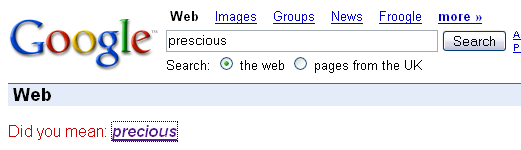
But if your word is spelled incorrectly, Google will suggest you a correct way of spelling (and the suggestion is a clickable word, so by clicking it you will get the results you had in mind when starting your search):

This works best with single words, and Google is mostly right about its suggestions. Still, because this suggestion is based on the number of search results found in Google's database, on rare occasions you could see Google suggest a wrong spelling for complex words, or simply not noticing a wrong spelling in your word and there not suggesting anything better.
Spell-check words using Google search: number of results
If previous tip didn't help you, then this one is definitely for you: pay attention to the number of search results returned with your query. This is another very useful way to check if you have typed your query correctly.
For instance, if you do search for the "prescious", you will see that Google finds only 145,000 results for it. While for "precious" it will return you 142,000,000 results. Another quite common error is to use "unfortunatelly" (456,000 results) instead of "unfortunately" (327,000,000), so you probably get the idea.
Simply comparing the number of results will make the proper spelling obvious almost every time.
Be warned though, that this way of spell-checking relies purely on the number of spellings of a certain word found on the web. So, if millions of people have written some word incorrectly, these search results numbers could be misleading.
Find word definitions with Google
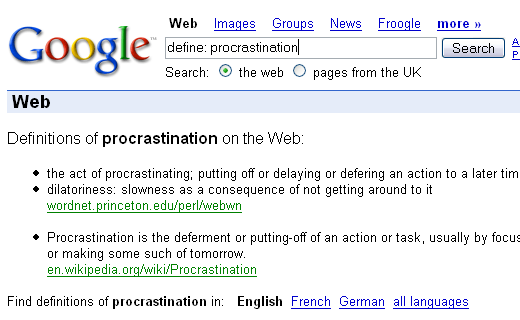
Another very useful feature of Google search is that it's very easy to find word definitions. Simply prefix your search query by the "define: " keyword, and you'll get something like this:
Ever been disappointed by your results?
Have you ever found yourself being totally depressed by some results you got doing something?
While most often the frustration comes from the lack of results, it’s not uncommon at all to be frustrated simply because the results you’ve got aren’t exactly what you hoped for. So this is the situation when you actually are getting some good results, only for some reason you still feel frustrated about them. This is when you should know: it’s probably a good time to review your goals and expectations.
Goals and expectations must be set, reviewed and adjusted regularly
I’d like to give you just an example of what I mean. Since I’ve adopted personal development as a lifestyle, I’ve seen such a tremendous boost in my self-growth and general life enjoyment (and I was growing and enjoying my life to start with, trust me on this one!), that I definitely am happy I took this path. Still, there are moments now and then, when I feel frustrated about the lack of progress I make in some aspect of my personal development, and the more I analyze reasons for such frustrations, the more obvious it becomes: most of our frustrations are because of the wrongly chosen goals and incorrectly set expectations!
Another major reason for frustrations is simply not having enough attention paid to align with your goals. Whenever you have set your goals, make sure you get back to them now and then to realise if your actions are all aimed at reaching your goals. You don’t want to spend few hours, days or even months spent working only to realise that half of your efforts (and that’s a very optimistic estimate) have gone the wrong direction and didn’t bring your goal any closer.
The third really big reason for being frustrated with your results is because of the lack (or total absence) of the time you take to review your goals and appreciate the accomplishments. In other words, not only should you regularly review your goals and make sure you’re working towards and not away from them, but you also need time to appreciate the achievements. Quite often you are in a position when something takes longer than you expected. But that’s a planning issue, not a goal setting one. So it is important to review your achievements to make yourself feel better – if you know you’re moving in a right direction, and if you have a list of accomplishments, and if you see that there are few more things to be done before you can finally reach the goal – that should be motivating, not discouraging.
For instance, back when I was only starting my personal development experiments, I had set a number of immediate goals which were directly based on the most obvious sources of my frustrations back at the time:
- I didn’t like the constant lack of time – and so it was a reason good enough to read more on time management.
- Some of my daily plans were not realised in time – and so I had to make proper planning arrangements and come up with a task-tracking system.
- I wasn’t learning enough in some areas of my interest – and so I had decided to discover new ways to find the time and motivation to learning even more.
All these major and minor frustration sources made my first goal setting an easy task. But what happens now is that, having reached these immediate goals, I have to set and aim the new ones. And it’s very important to always maintain the focus and appreciate the work you’ve already done.
I have many days when there is quite a number of things left unfinished or not even started by the end of a working day. Having just a couple of unfinished things is already enough to be a minor frustration. And that’s the last thing you want to happen at the end of an otherwise successful day, isn’t it?
It took me a bit of a discipline to learn the habit of doing a full-day overview, involving both finished and unfinished tasks, before I could learn to stop my frustrations completely. It’s really this simple: don’t ever let an unfinished task shadow the joy of having all the rest things done on time. Focus on the results you’ve got and appreciate how they bring you closer to your goals!
Knowing your goals is really important
If you’re a beginner, just make sure you have some goals set initially and that you’ve given each goal a thought. As you progress and become more and more comfortable with your self-growth, start keeping track of your goals and appreciating the progress you’re making towards them. And once you feel absolutely comfortable doing this, start reviewing your goals, adjusting them accordingly and even set brand new ones!
So here’s a very simplistic view on my approach to goal setting:
- set and know your goals
- keep track of your goals
- review, adjust and set new goals accordingly
There is no winning formula for timing these three stages. Their importance will grow as you grow personally. But it is always a good idea to know and review your goals, cause doing helps you discover just how much you’re really doing, and how quick you’re growing and where.
Our little angel, Elizabeth, just turned 4 months a week ago. She’s growing so fast that sometimes I’m too excited to take notes about her development and our impressions, but it’s been a while since I posted anything about here, so today I’m filling this gap and reporting our parenting impressions and baby’s development progress.
I must confess, I’m absolutely shocked how the mother nature makes a child develop only the most essential skills! Have a look at the list of some new essential skills Elizabeth has just mastered:
- holding her milk bottle with her own hands
It pleases everyone to see that she’s quite capable of holding her bottle herself. This probably gives her more control over the situation, as she definitely smiles more when she’s holding her bottle.
- pulling the soother out and pushing it back into her mouth
How cool is that?! Frankly, this was a surprise. We didn’t notice when it happened the first time, so when we finally saw her doing it, she looked so confident and determined that we all laughed. It looked as if she knew how to do it all time along, and simply didn’t feel like pulling the soother out before.So, if there’s anything important she has to say, or simply if she doesn’t enjoy the soother anymore, she simply pulls it out and throws it away. She also looks very funny when she suddenly misses the soother and tries pushing it back into her mouth.
- pulling someone else’s hair
Oh yes, this skill is definitely a must have for any child. We simply didn’t expect Elizabeth to master it so quickly and so early :) Now we have to be really careful approaching her, cause she waves her tiny hands randomly trying to catch your hair, and when she does, there isn’t much you can do but ask for someone else’s help to rescue.Elizabeth clearly enjoys pulling hair very much: she smiles and giggles, and naturally expects you smile in return. Maybe it is time to finally get a kitten we’ve been thinking about for the past few months? When playing together, it will hopefully keep them both mutually interested and somewhat occupied when the girl catches the kitten and tries expressing her love by gently pulling hair out of the poor thing.
Overall, we’re still incredibly happy watching our little girl grow and become a person. I guess, parenting is really one of the most rewarding periods in your life at this early age. You see your baby grow and learn something new every day, and the more time passes, the more conscious and pleasant relationship you establish with your child.
Elizabeth has plenty of enthusiasm, lots of curiosity, and is very determined in her achievements. I wonder what skill she’s going to develop next? Can’t wait to see her learn something new! I guess that’s what parenting is about ;)
Today marks the 5th month of this blog. And while it’s nothing like a real anniversary, it’s a day good enough to make a few (hopefully) positive changes to this Personal Development blog:
- Quick And Effective Reading
I think it’s about this series gets its own index page. For those of you following the series, it will make it easier to navigate the articles. And for visitors completely new to my blog, this page will provide short description on each of the articles to make sure you’re never lost looking for certain asnwers in my articles.So, here it is: Quick And Effective Reading series.
Enjoy! And yes, if you have some suggestions on making this series even better, be sure to let me know! Thanks!
- Articles count for archives
Since I’m already showing how many articles there are in each of the categories of my blog, I thought it would only help to have similar counters shown for monthly archives.
- Full RSS feeds
Although having only article excerpts shown in RSS potentially makes more readers open the browser and visit the relevant article page, I really don’t want to make this decision for you anymore. Do whatever suits you best – be it reading the blog through RSS, visiting its pages or subscribing to the e-mail newsletter (yes, I’m planning to start offering one very soon).